- Corporate Affairs Unpacked
- Posts
- A CEO's voice can drive the share price
A CEO's voice can drive the share price
New research reveals that the tone and content of a CEO's comments can lead to outperformance

Helen Dunne
March 19, 2026 • Estimated Reading Time: 5 minutes

Having suffered from an acute bout of verbal diarrhoea in the days of the pandemic, many CEOs have dialled down the rhetoric in recent years, but new research from Korn Ferry suggests this might not be a good idea, particularly for those new to the role who have yet to make their mark.
Indeed, the report Leadership Signals in Earnings Calls actually claims that strong leadership voices result in a 12pc share price outperformance against competitors, while the share price of companies where the CEO was deemed not to possess leadership qualities could underperform by as much as 15pc.
Using large learning models, Korn Ferry analysed more than 540 earnings calls from 90 S&P 500 companies in the 18 months following the appointment of a new CEO between 2015 and 2016. Analysis of share price data continued until the end of 2019, and was benchmarked against industry trends.
While the nature of the calls was financial, the research first examined them from a leadership perspective and then considered the substance of what had been said. Obviously, a large portion of these calls will be scripted, but the Q&A sessions can be harder to rehearse and Korn Ferry’s analysis also builds on studies that reveal how subtle cues, such as hesitation or avoidance, can shape investor reactions.
There’s a lot of science underpinning its research (and some of those weird spider web charts that I can never understand), but, essentially, Korn Ferry has identified eight leadership themes that are associated with market performance.
You may not be surprised to learn that egocentricity, where the CEO talks about ‘I’ rather than ‘we’, or ‘me’ rather than ‘team’, has a negative impact on share performance. Top performers speak about success in collective terms.
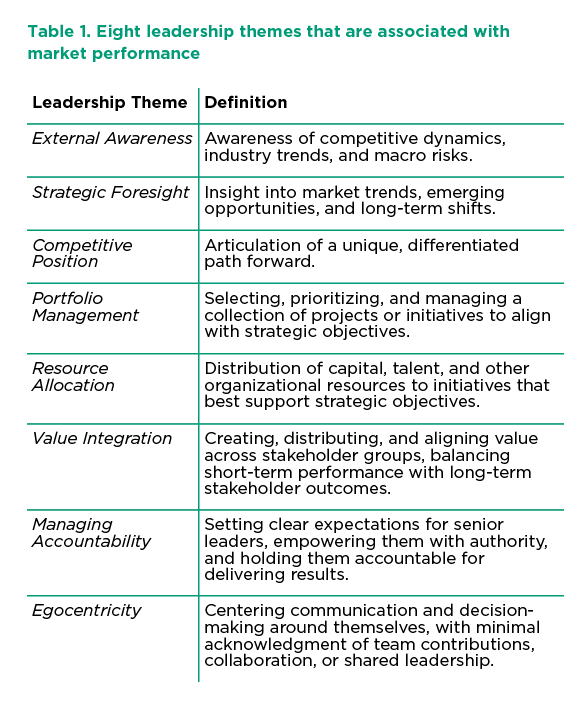
Source: Korn Ferry
Another that will resonate with corporate affairs professionals is ‘external awareness’, the importance of reflecting the global environment in presentations. Today’s CEOs are asked about issues, such as geopolitics, tariffs or AI, far more than their predecessors, and this research reveals those perceived to have a weak grasp of such issues were five times more likely to be underperforming than their peers.
Korn Ferry recommends CEOs getting ahead of such questions by articulating their impact on the business, being empathetic, authentic and, because nobody owns a crystal ball, neutral! The consultancy also suggests that it is wise to have a view on external events, even if they do not directly impact the business, suggesting this is an opportunity to be a ‘thought leader’.
But avoid making political statements, which risk being polarising and acting as a lightning rod for controversy, as stock markets do not like surprises.
The caveat to these findings, which Korn Ferry concedes, is that the research analysed data from ten years ago, in part to ensure that the pandemic did not skew the results.The answer may just be contained within a new report by executive search consultancy Hedley May.
CRISIS PREPAREDNESS
It’s always the small things
Whenever I speak to a comms director who has survived a corporate crisis, there is always one small detail that somehow was neglected in scenario planning but, in hindsight, proved important. I recall one crisis where the response was delayed because nobody knew who was in charge of the company website, and then, having identified the person with the power, discovered they were on holiday, requiring a second search.
More recently, I’ve heard about the importance of keeping the active directors list up-to-date. This really represents the Crown Jewels in the event of a cyber-attack, sought out by the miscreants, just as they trawl for the cyber insurance documents when they first get access to assess what they can demand.
Hackers do a tremendous amount of reconnaissance before going live. One victim of a cyber hack told me that he had previously noticed a lot of Russian views of his LinkedIn profile. Weeks later, his IT guy had the same experience. Perhaps that should have alerted them to the imminent Moscow-sanctioned attack… but they lived in blissful ignorance until that fateful day.
If there is a discrepancy in the active directors list, it will be found and exploited.
And finally – following much to-ing and fro-ing on dates – I am pleased to announce that Cyber Unpacked, a one-day event including a two-hour crisis simulation, will take place on 2 June. Details will become available soon. But to register interest, please email [email protected].
CORPORATE PURPOSE
Purpose in action
On 31 January, Doug McMillon stepped down as CEO of Walmart Inc, the world’s biggest company in revenue terms, after 12 years at the helm. Over his tenure, shares in Walmart have risen by more than 420pc while its market capitalisation has trebled in size.
But when McMillon, who had first worked at Walmart unloading trucks during secondary school, took over, the retailer’s reputation was in tatters. It was suffering a triple whammy of dissatisfied shoppers, disillusioned investors and disengaged employees. Profits were flatlining. Indeed, customers were actively boycotting stores out of sympathy for the staff.
Some CEOs in a similar situation might go down the management consultancy route, but McMillon took a different journey. On his first day, he got into a Walmart truck and rode alongside seasoned drivers, unloading cargo and hearing their gripes. He then spent time visiting stores across the country, hearing first-hand why colleagues were so demoralised.
The story was always the same: pay was too low, manager roles had been cut resulting in leadership vacuums, hours were unpredictable and career progression was undefined. Without pride in the business, stores were looking tatty and unloved. Without clear direction, stock was piling up.
McMillon realised that what had, arguably, worked in the past to create the world’s biggest retailer could not guarantee its future. This resonated with the Walton family, which owned 50pc of the shares: decisions, they believed, should be made for the long-term.
At the heart of McMillon’s three-part strategy was a $2.7 billion investment in Walmart’s people, not only raising hourly rates, but offering better training and clear career paths. The Walmart Foundation would also commit $100 million over five years to improve the career prospects of entry-level retail workers. It was just the start - but it would also impact Walmart’s already creaking profitability.
When McMillon publicly unveiled the plans, predicting flat revenues for the following year, and a hit ranging between 6pc and 12pc on earnings, Wall Street took flight. In just 13 minutes, Walmart - the world’s largest private sector employee - lost $21 billion in market cap.
Now obviously, McMillon did more than just invest in Walmart’s two million colleagues - he accelerated digital transformation and improved decision making through advanced data analytics, for example - but putting its people first has paid dividends (literally) for the business.
I think of this story as a great example of purpose in action. And on 21 April, we will be sharing more real-life examples at a one-day event, entitled Purpose Unpacked. (Yes, it was initially going to be called Purpose In Action but a URL purposeinaction was not the message I wanted to send!)
Speakers from Yorkshire Building Society, Lloyds Banking Group, Met Office, Exchange for Change, Legal & General and fresh produce company Fyffes will be sharing their stories, demonstrating how purpose acts as a galvanising force within their organisations.
And we’ll hear from Second Chance Partnership, a not-for-profit spun out of Iceland Foods, that works to rehabilitate ex-offenders, and the Rothesay Foundation on the art of strategic philanthropy.
There will also be thought provoking sessions, offering advice on how to embed social value across strategy, operations and partnerships, how to rethink purpose in an uncertain world and how it should be positioned and framed.
And that’s just the planned discussions: as everybody knows, that chats at the fringes are also often valuable. Sign up on the link below.

Other dates for your diaries
CorpComms Awards open for entry: 30 March
CorpComms Awards close for entry: 5 June
Corporate Affairs Summit Dublin: 28 May
Cyber Unpacked: 2 June
Corporate Affairs Summit London: 7 October
To register your interest in each or any of the above events, email [email protected].
Please note: both Corporate Affairs Summits are only open to senior in-house communications professionals. Tickets will go on sale shortly.