- Corporate Affairs Unpacked
- Posts
- Articulate CEOs can boost market caps
Articulate CEOs can boost market caps
New research claims that CEOs who deliver high-quality thought leadership can add millions to a share price

Helen Dunne
April 12, 2026 • Estimated Reading Time: 5 minutes
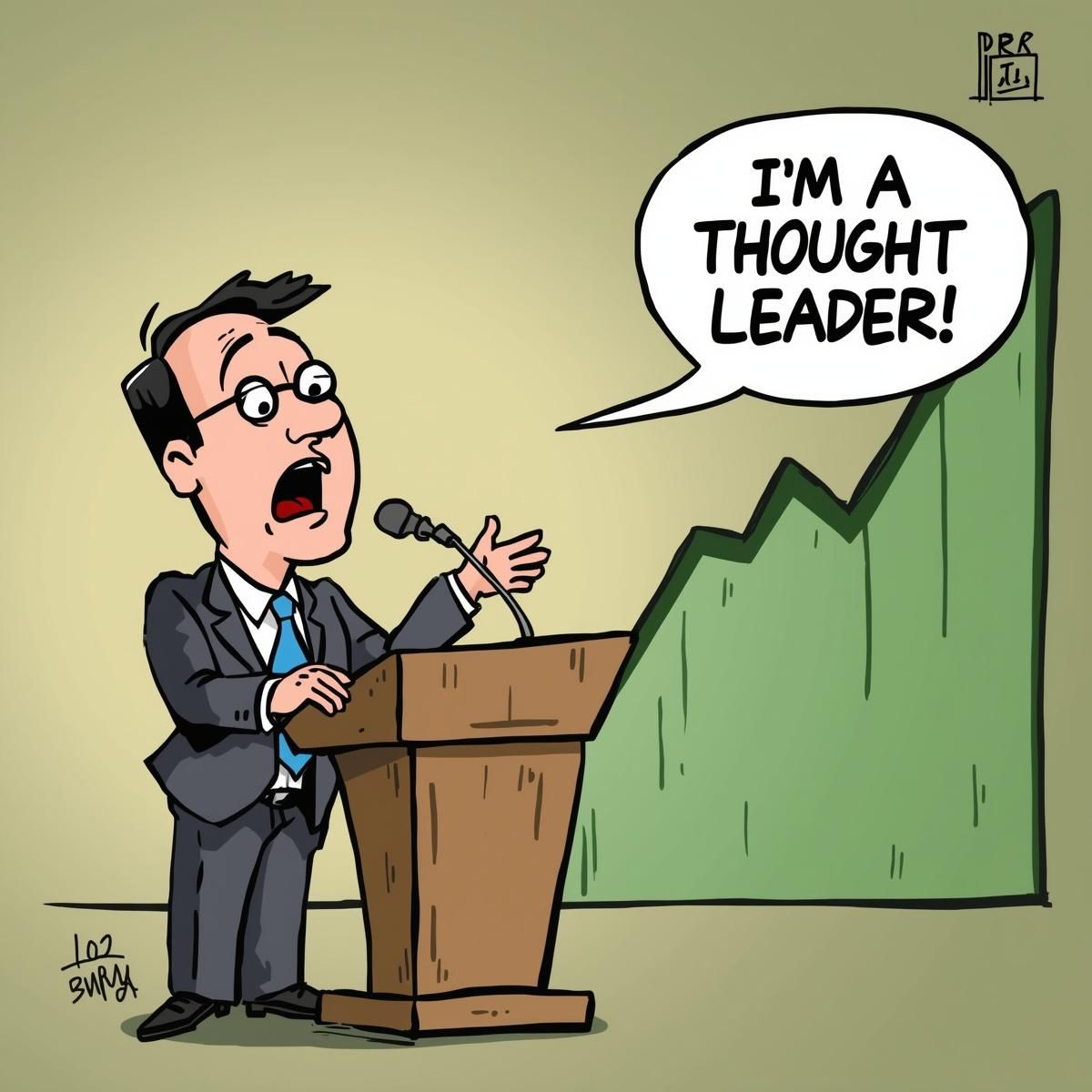
Ever wondered if your CEO’s thought leadership pieces could move the share price?
Well, wonder no more.
A new report claims that high-quality content delivered by a CEO could add $367 million to a medium-sized S&P 500’s market cap in one week.
It adds that the disparity between CEO communications deemed high-quality and those viewed as low-quality can equate to a 0.9 per cent difference in a company’s share price over a period of seven days.
US-based consultancy Cardinal40 analysed 1,034 examples of bylined op-eds, public speeches and testimony, interviews and public statements and annual shareholder letters, while excluding any communications relating to market-moving information, such as quarterly earnings. Each piece was measured against abnormal stock returns over one week.
Now, before you go rushing to dash off a new tome for the CEO, there are a few caveats. Firstly, Cardinal40 specialises in thought leadership – which means it may have a vested interest in these findings.
Its researchers also admit that they didn’t consider factors, such as whether a speech coincided with a specific event, a product launch perhaps, or whether the timing was strategic.
Similarly, the research only considered publicly traded US companies, where there was sufficient trading information and easily accessible communications. The finding might not, therefore, translate to non-US markets or private companies.
And finally, this study does not prove causation. Nor does it claim that each example of top quality CEO thought leadership will add $367 million. Measurements like this are, by their nature, imprecise.
But that doesn’t really matter. What the research demonstrates is that, when a CEO publishes a piece of thought leadership, the quality of their thoughts and the way in which they articulate their vision does create value independent of material information (such as financial results).
As Cardinal40’s founder Ryan Jacobs puts it: ‘A CEO’s words aren’t a vessel for value created somewhere else. The words are the value.’
CORPORATE REPUTATION
Why does sorry seem to be the hardest word?
Sir Elton first pondered this very issue back in 1976. It’s a sad, sad situation. And, frankly, it’s getting more and more absurd. I’m talking about performative apologies.
Caught in flagrante delicto with someone other than your partner? Express remorse at the hurt you have caused. Blame it on an addiction (s*x is always popular – as an addiction, and otherwise 😉) or a momentary lapse in judgment. Either book yourself into a rehab facility or pose with a forgiving partner at your side (preferably gazing lovingly at your cheating face).
Drunkenly fondled a client or colleague at a business event? Apologise for the demons you’re battling due to [delete as appropriate and/or fashionable] childhood/acute/intergenerational trauma. Stress you are getting the necessary help. Ask for love and support at this difficult time. Thoughts and prayers.
Facing a backlash after selling t-shirts adorned with swastikas and singing lyrics lionising Nazism, take out a full-page advertisement in a national newspaper expressing your love for Jewish people. Blame your poor judgment on a previously undiagnosed bipolar disorder.
I will admit that I half expected Kanye West to make a (highly publicised) pilgrimage to Auschwitz in the wake of his apology. It’s a well-trodden path for celebrities attempting to atone for antisemitic comments or actions.
But no, West (estimated wealth: $400 million) decided that simply expressing remorse in one print newspaper with just over 400,000 subscribers would suffice (estimated cost: $200,000), although admittedly the story was widely covered in the world’s media.
Yet, he didn’t consider that his words and actions had consequences, far beyond either the Wall Street Journal’s circulation or North America’s borders. He didn’t try to build bridges with the Jewish community, apart from one well-publicised meeting with a celebrity Rabbi.
And he certainly didn’t attempt to apologise to Britain’s Jewish community until there was public outrage at the news he was to perform at Wireless. Perhaps if he had privately made contact prior to the announcement of his headline gig, to understand their very real fears in the current febrile environment, the outcome might have been different.
Imagine if he had donated some of his reported $15 million appearance fee to Jewish charities and support networks. Or even quietly made a donation to the Hatzola ambulance service in North London in the wake of its appalling attack.
There were countless ways in which West could have demonstrated his support for the Jewish community and contrition at his past behaviour. A one-page advertisement doesn’t make the hurt disappear. Unlike his visa.
(I’ve deliberately ignored the behaviour of Melvin Benn, managing director of Festival Republic, promoters of Wireless. Suffice to say: when you’re in a hole, stop digging.)
PUBLIC RELATIONS
The numbers don’t add up
Being a simple soul, I always thought that it was relatively cheap to set up a PR agency. You need a little black book stuffed with journalists’ (and now influencers’) info, a mobile phone or two, a laptop and maybe a basic website plus technology stack.
But according to Lawrence Rosenberg, a semi-finalist in Thursday’s episode of The Apprentice, you need £5.5 million. Despite entering a reality television show where the prize is a one-off investment of £250,000, Rosenberg’s 75-page business plan revealed he actually wanted 22 times that amount. (Thankfully, he’s not going into financial PR.)
Rosenberg told the other finalists that he needed that much money because he was essentially building a tech company, rather than a PR one, and he did spout on about creating portals for clients to access assets and such like to one interviewer.
Spoiler alert: Rosenberg didn’t get Lord Sugar’s investment. But he’s pushing ahead with his plans to ‘reinvent public relations’, having launched Rosenberg.Media – with not one whiff of AI on its website. Or £5.5 million in the bank. And services that sound like, er, good old-fashioned media relations. Plus ça change.
PUBLIC RELATIONS - AGAIN
Dear Lord, please save me…
As regular readers will attest, I am a model of restraint – always here with a kind word or friendly jest about the world of communications. Never critical. Always supportive. But sometimes, alas, even Miss Congeniality reaches her limits. And this week it came in the form of a ‘press release’, and yes: the quotation marks are intended.
Scotland’s creative economy hits record high, declared Muckle Media, an agency that proudly claims to work at ‘two speeds’. Now you might assume (as I did) that this claim was backed by new econometric modelling. But you’d be wrong.
In fact, it was about The Marketing Society Scotland announcing the shortlist for its Star Awards, having received a record number of entries. A non-story, really, but one with a totally confected explanation.
According to Muckle Media, this ‘surge’ in entries was driven by a shift towards ‘high-value integrated campaigns and a record-breaking influx of young talent, as an unprecedented number of students enter the industry’.
What absolute tosh! And how dismissive of the contribution of experienced practitioners. It’s all down to the Gen Zs, don’t ya know! Isn’t everything?
But aside from that, in my experience, it is a fool’s errand to predict the number of award entries in any given year. It depends on budgets, existing time commitments, somebody taking the initiative, the willingness of clients to participate et cetera.
What a record number of entries does not signify is a more creative economy. But it may signify better marketing of its awards by The Marketing Society.
In fact, the release is littered with unsubstantiated claims – or, as I prefer to call them, waffle – and statements of the bleedin’ obvious.
Exhibit A: ‘The figures signal a robust recovery for a sector…’ They don’t.
Exhibit B: ‘During a turbulent time… the campaigns earning recognition are those that deliver measurable strategic value.’ Go figure.
And you thought journalists only moaned about irrelevant press releases (of which this is also guilty). No, they’re also irked by meaningless dross. I am not sure at which of Muckle Media’s two speeds this release was written, but I know at what speed my finger hit delete. And that really was a record.
Tickets are still available for Purpose Unpacked, a one-day event covering everything you needed to know about purpose but were too afraid to ask! Apparently, there have been some issues with the URL - due to it being a new website - but my understanding is that these should alleviate this week. If you find difficulties accessing the site, please let me know and I will send across a PDF version of the programme.

Other dates for your diaries
CorpComms Awards open for entry: This week
CorpComms Awards close for entry: 5 June
Corporate Affairs Summit Dublin: 28 May
Cyber Unpacked: 2 June
Corporate Affairs Summit London: 7 October
To register your interest in each or any of the above events, email [email protected] or (for the summits) [email protected]. We will be in touch shortly with further details.
Please note: both Corporate Affairs Summits are only open to senior in-house communications professionals. Tickets will go on sale shortly.