- Corporate Affairs Unpacked
- Posts
- Do we trust the BBC?
Do we trust the BBC?
Or do we just trust it in some areas and not others?

Helen Dunne
November 16, 2025 • Estimated Reading Time: 8 minutes
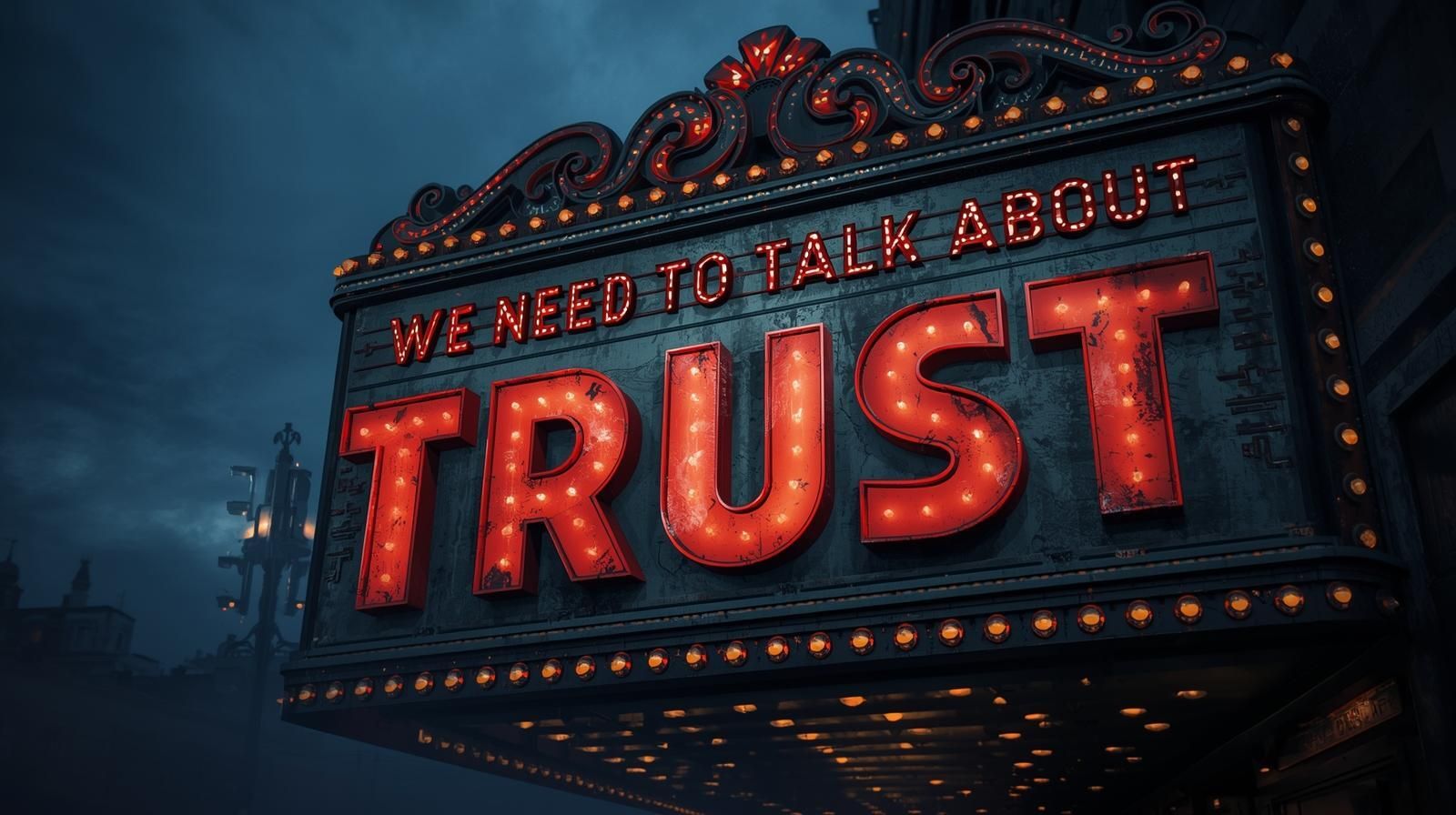
Ahh. The BBC. What can I say that greater men and women have not already opined this week? Well, apart from marveling at the Beeb’s ability to generate a story in a slow news week, that affords three journalists employment – the news anchor interviewing a journalist in the studio before going ‘live’ to another colleague outside BBC headquarters to discuss the latest debacle (without any of the trio acknowledging the irony of the situation) – I think this really all boils down to trust.
The bane of any journalist’s life is space (print) and time (broadcast). When I covered press conferences (remember them!) as a print journalist, I would be assigned anything between 250 and 500 words to write my summary of what might have been a two hour event.
I would rely on my news judgment to ascertain what the key points had been. If I needed to splice a quote to save words, I would use ellipsis to indicate that it had been abridged. If the quote was contentious, I would likely be asked to submit my piece to the newspaper’s in-house lawyer, who would ensure it was a fair representation.
But I might still have had a different view from peers on other newspapers. Witness the infamous speech by former jewellery tycoon Gerald Ratner, in which he belittled both his products and customers, to the Institute of Directors.
He had repeated the same ‘jokes’ in an interview with the Financial Times previously, but they were part of a longer feature and did not cut through. But heard by another journalist, who viewed them in an altogether different light, they became the thrust of his article – precipitating the demise of Ratner’s empire. Both articles were accurate representations of what had been said: they just had different perspectives.
Broadcast journalists have an even harder job. Summarising an hour long speech into a 90-second clip is a skill. Viewers trust that the thrust of that clip conveys the meaning of the speech. There are no visual cues to represent edits.
So when BBC viewers saw Donald Trump appear to condone his supporters marching on Capitol Hill; they believed he had incited violence. They saw no need to watch a fuller version, or check on the veracity of the BBC’s interpretation, because they trusted the news journalists. Implicitly, they believed the summary had been rigorously checked.
But trust in the BBC is complex. The Beeb’s most recent annual report claims it is the most trusted news provider in the UK. Indeed, it uses the word ‘trust’ 91 times in the 226 page report.
Yet such trust is already highly polarised, according to a recent survey, varying according to political affiliations, gender and age.
It brings to mind a presentation by Dr Steven Van Riel, a behavioural scientist who is UK head of insight and performance at Teneo, at this year’s Corporate Affairs Summit. He divides trust into Trust with a capital T, and trust with a lower case t.
Many business leaders speak about the importance of Trust, when they’re alluding to a giant amorphous blob, dependent on so many factors, and almost impossible to manage.
And, as Van Riel pointed out, too often people correlate this ‘most abstract and generic measure of trust with the most abstract and generic measure of business performance’. Yet the evidence does not support this: true, some trusted organisations outperform but there are multiple examples of organisations or individuals with poor reputations thriving.
Van Riel contrasts this with small t trust. Trust from very specific audiences. Trust to do one thing right. As he said: ‘Separating out your consumer trust from your employee trust from your investor trust as being genuinely different things, where they're asking you to do different things and are different groups of people.
‘Where you can map it onto specific relationships within the business and see where those levers of value have an element of trust in them that is quite detailed and quite specific. And when you think about trust in that way, proving the case for trust moves from being ambiguous to actually almost intuitive.’
For example, if employees trust their managers make decisions fairly, they are less likely to challenge promotion decisions, while consumers might trust brands in some areas, but not others. Based on personal experience, I may not trust Ryanair to deliver my luggage to my holiday destination, yet I trust the airline to offer low fares and, in the main, be punctual.
The more specific these metrics are, the better informed a brand is to tackle them. Trust should not be a moral crusade, but instead viewed by its specific impact on business. This gives legitimacy to corporate affairs, who are better able to argue that trust matters for a specific subset of an audience, say, and the likely impact of tackling that.
As Van Riel pointed out, audiences don’t have 90-point score cards for every business they encounter, but base their views on intuition, emotions, relationships and prejudices.
‘If you make trust something small, something that's measurable, something that's specific, it actually gets you [corporate affairs] into those grown up conversations as a function much more credibly and much more easily than coming in with one big idea that solves everything,’ he said.
What does this mean for the BBC? Observers have conflated this as a capital T Trust issue, rather than a small ‘t’ one. Twelve million people tuned into the final of Celebrity Traitors, ironically a game about trust, indicating viewers trusted the BBC to deliver a stunning denouement, and likely trust a second series will be just as good, if not better.
Sir David Attenborough is regarded as a national treasure, and his natural world documentaries are trusted worldwide.
But viewers need to trust that the BBC is not a giant echo chamber, where reporters are influenced by personal political biases. The key is for the BBC to work out where – and which – small t trust has been breached, which are the audiences most impacted, and then to decide the steps to tackle these.
Addendum:
Basil Towers, a doyen of the industry, shared the stage with Van Riel, and spoke about research he is currently undertaking, which asks if there is merit in deliberately earning trust and is it feasible to do so? ‘And if there is merit in doing that, how are we doing to do that? Is it feasible to do that? What business choices would you have to make to either act differently, behave differently, or engage and communicate differently?’ he asked.
It is challenges such as these that makes Towers, who has spent the past 35 years advising corporate affairs directors, believe that there has never been a better time to be in the industry.
IN CONVERSATION WITH
Suman Hughes, vice president, communications, Mastercard

Image by Rebecca Cother, Honkey Donkey
Suman Hughes has her English teacher to thank for her career. Mastercard’s vice president of communications had planned to study journalism at university, but, after her teacher arranged work experience at Bromley-based agency, Shirley Dunmall PR, her plans changed. ‘I wanted to be a journalist. I thought it was super-glamorous. And I’d never heard of PR, to be honest,’ recalls Hughes.
‘[The agency] was basically just Shirley, and she specialised in hair care. She had [celebrity hair colourist] Jo Hansford and all the top Mayfair hairdressers as her clients. I was 17, getting black cabs into London, thinking this is much more glamorous. I want to do this.’ Hughes went on to do a PR degree at Bournemouth University. ‘I completely changed what I was going to do based on one week’s work experience, and really only because I thought it was super-glamorous.’
MEASUREMENT
Proving your value
PR measurement is in a state… oh, sorry. Let me try that again. The State of PR Measurement, produced by Muck Rack, found that three per cent of PR professionals, and I’m using that time lightly in this context, do not measure their work, while 16% say it depends. On what? The weather, the time of the month, Arsenal’s performance…?
What a depressing state of affairs. It also explains why some entries to the CorpComms Awards lay out their objectives at the start, but then fail to refer back to them again. Or produce a completely random set of results that bear no relevance to initial objectives.
As one past judge said, it’s like setting out on a car journey to Blackpool but arriving at Brighton – and viewing that as a successful trip. It’s the coast, innit?
The survey, which had 832 respondents, found that, while 82% believe measurement to be ‘very’ or ‘extremely important’, the rest were ambivalent. And yet, it doesn’t have to be a time intensive task: the majority of respondents spend between one and four hours measuring and reporting on their work.
If you don’t measure or track your work, how can you argue for the importance of communications to leadership? Nine in ten say that demonstrating impact is the primary reason for doing so, while 65% claim it helps to inform and adjust strategic focus.
Worryingly, though, the report indicates that, while three in four PR professionals claim their work is ‘somewhat’ or ‘very closely’ tied to business goals, 16% say there is no link. And nine per cent are not sure.
In other words, they’re not sure why they are doing what they are doing… no wonder they’re not keen on measurement. It might reveal that their work has absolutely no impact on the bottom line, apart from blowing a hole in it.
I almost admire their honesty in admitting as much in the survey, but if communications is going to be taken as a serious function, it has got to weed out those players that can be held up as Exhibit A by the sector’s detractors.
SPONSORED BY BLAKENEY
Our job when the world no longer makes sense
We’re used to creating clarity from chaos in corporate affairs. But what we face now is different in both scale and intent. The people who shape markets, narratives, and political agendas now act in ways we can’t forecast.
For corporate affairs leaders, that changes the job.
We are no longer managing issues – we’re managing volatility. That means scanning for signals, assessing intent, and understanding who is really driving events, so you can see how every corporate decision will collide with political consequence.
It also requires continuous readiness. Most organisations will face a major crisis within five years, and the biggest point of failure is always leadership behaviour. The teams that recover fastest build muscle memory long before they need it; that’s because, when a crisis hits, leaders behave as they have been trained. If they haven’t been trained, they default to fear, denial, or delay.
So the call to action is simple: prepare your leaders, build trust, and redesign how your function interprets the world and makes decisions.
Because the real dividing line is now not between good and bad crisis management, but between teams that are ready for the world as it is and teams still hoping it will go back to what it once was.
Only one of those survives.

ODDS & SODS
⛰️ Patagonia this week produced its first impact report, which it calls a Work In Progress report, is an examplar. It has been described by many commentators as a lesson in authentic communications, being candid about Patagonia’s successes and failures and the challenge of being a responsible business dedicated to saving the planet, while government policies seem to reward those who succeed by exploiting it.
A review of its 2025 goals, set in 2015 with the understanding that they were aspirational, inspirational and outcome-oriented, asks: ‘How’d we measure up?’ A goal to become carbon neutral was ditched after it recognised the irony of buying offsets while continuing to pollute: instead, its goal is now to clean up its supply chain to stop polluting in the first place.
But this quote from its CEO, Ryan Gellert, summarises the challenge faced by every sustainable business. ‘Patagonia is a paradox. Our charter mandates we follow social and environmentally responsible practices, yet every product we make takes irreplaceable resources from the planet. Our existence seems counter to our purpose. That tension is not lost on us.’
💰 Our awards coincide with this year’s Budget – well, sort of: they’re in the evening – so I probably won’t be focused on what Chancellor Rachel Reeves says during that day. It’s many years since I was tasked with precising the Red Book down to 1,200 words in, er, 90 mins or so for a print edition, but I do remember the panic around the City office.
And the constant messages from sources wishing to contribute. Joe Mayes, UK political reporter at Bloomberg, offers advice for communicators looking to get coverage for clients on the day.
He recommends: ‘Punchy, clear quotes that take a strong view. Keep those comments short and sweet. Wow me with your boldness and brevity.’
Speed is also of the essence: journalists are under pressure to file as soon after the Chancellor sits down as possible. But, Mayes also suggests briefing in advance (and in confidence) if your client has picked up any sort of signal from interactions with government which may prove to be of interest.
🙊 Wicked whispers: I hear rumours that a vacancy may soon be arising at a FTSE 100 retailer as the present incumbent takes up a new role in Europe. Just saying….
🆕 If you’re thinking of changing roles, be prepared for interview hell. The latest Mini View from search consultants VMA Group, which surveyed more than 500 communications professionals, finds that 8% of those who secured a new job undertook more than five interviews to get there.
Just 19% were lucky enough to get away with one interview, while six in ten had between two and three. But almost half of those (48%) who changed roles applied for more than ten before securing their position.
The leading motivations for changing roles were salary and benefits (55%), career progression (44%) and 41% talked about the desire for a new challenge – they just didn’t see the first challenge as securing an interview.