- Corporate Affairs Unpacked
- Posts
- Is it curtains for purpose?
Is it curtains for purpose?
Reconciling conflicting views on the role of corporate purpose today

Helen Dunne
October 30, 2025 • Estimated Reading Time: 9 minutes

While the clocks went back on Sunday, it seems this week’s newsletter also retreated… For various reasons, which are just too boring and personal, it was tricky for me to write/complete the tome. Rather than miss another week, I elected to send this later, but will return to the normal schedule on Sunday. Apologies.
An intriguing conundrum arose at the Corporate Affairs Summit.
In the opening session, Alex Gordon Shute, founder of Ithaca Partners, shared insights from a benchmarking review that the search consultancy had recently completed, which involved 51 of the FTSE 100. (Further details will be shared in upcoming newsletters.)
The findings revealed that purpose had been downgraded as growth becomes the dominant principle of corporate affairs, with 54% claiming their top priority is to drive company strategy.
While I would argue that the two are not mutually exclusive – witness the commerciality of Lloyds Banking Group’s purpose, Helping Britain Prosper, with initiatives such as funding for social housing – the environment today, as Gordon Shute explained, is somewhat tricky for business.
Surprisingly, though, in almost every ensuing session, the topic of corporate purpose arose, as delegates talked about ‘North Stars’, culture and guiding principles.
I was finding this anomaly difficult to reconcile, until the release of Anthesis Group’s latest Purpose Gap report. It revealed that, for the first time in four years, the difference between what organisations say about their purpose and how it is actually delivered has widened.
A nine-point increase from last year means 61% of employees now say that their company’s purpose statement does not match the reality.
Echoing Gordon Shute’s comments about the prevailing environment, the report says: ‘Geopolitical instability, shifting regulations, ESG pushback and a cooling of sustainability investment all add to the pressure. As a result, many organisations are retreating.’
And yet, here’s the twist: others are doubling down. Anthesis Group found that the share of employees who see full alignment between purpose and practice rose significantly from 22% to 35% year-on-year. In a polarised world, purpose is polarising.
The findings echo a recent Harvard Business Review survey of 75 global companies which found that while, 13% had rowed back on their purpose commitments, 50% were carrying on as before but just not talking about it, while 30% were actually accelerating their progress.
Of the 13% that had ostensibly rolled back, 5% had simply changed the way they talked about purpose. In simple terms, just six of the 75 companies had retreated.
On closer investigation, Anthesis found that the purpose gap has narrowed in three main sectors. In IT and telecoms, the gap has shrunk from more than 60% to 40% as ‘a culture of innovation and agility… makes it easier for purpose to be felt and lived across teams’. In manufacturing and automative, ‘the shift to electrification and circularity has made purpose a business imperative’.
And in financial services, ‘purpose is being aligned with sustainable finance and impact capital’, helping firms navigate compliance while driving long-term value’. In the energy, healthcare, retail and hospitality sectors, which have been hardest hit by the cost-of-living crisis, the gap has widened - as companies have been forced to make hard choices.
Does purpose still matter? Yes, is the overwhelming response from Anthesis. Its survey of more than 1,000 employees found that 91% believe purpose remains important in today’s climate, and this number rises to 98% of C-suite executives, suggesting it remains integral to business strategy.
And more than 66% of respondents, up from 47% just one year earlier, suggest they would consider leaving their role if their employer failed to deliver on purpose. In the interim, they likely become apathetic, suggesting businesses where purpose is floundering are being negatively impacted in three ways: disengagement, churn and reputation. In other words, there is a clear financial cost.
That’s not to say that all companies with a corporate purpose thrive in a world of milk and honey. As Sarah Gillard, CEO of A Blueprint for Better Business, opined at the Summit, part of the backlash against purpose resulted from people assigning too much power to simply creating a purpose statement.
It doesn’t exist in a silo. It needs to be embedded throughout an organisation, into the strategy, culture, governance, the decision-making processes… it’s the keel, she explained, that keeps a boat steady while you navigate the currents. It enables an organisation to consider trade offs, to better understand different stakeholder groups, to make better decisions that have a greater legitimacy. It’s not words on a page. Or a marketing campaign.
A final interesting point emerged from the Anthesis analysis. Purpose thrives when people feel close to it. In big companies, purpose can get lost in bureaucracy… it can get diluted or misunderstood, like Chinese whispers, as it cascades through an organisation. Employees in smaller companies feel much more empowered to act on purpose than their peers at larger businesses.
Somebody needs to point this reality out to the big bosses. Almost two thirds (64%) of C-suite executives feel empowered to make decisions using the company purpose, but this drops down to 28% for entry-level employees and 41% for middle managers.
But the C-suite also think that everything is fine: 64% believe their organisation is ‘completely aligned’ over its purpose and actions: just 24% of their employees agree. Ignorance is not bliss, in this case!
IN CONVERSATION WITH
Tabitha Aldrich-Smith, associate director, communications and engagement, Met Office

Illustration by Rebecca Cother, Honkey Donkey
Whenever a compilation of TV bloopers airs, it likely contains a 1987 clip of former BBC TV weather presenter Michael Fish in which he dismisses rumours of a hurricane. Just hours later, the worst storm in three centuries hit South East England, causing more than £1 billion of damage, killing 19 people and uprooting 15 million trees, including six of the seven oaks that gave the eponymous Kent town its name.
Back then, the Met Office’s weather computers could process about four million calculations a second – less powerful than a mobile phone today – and relied on about 1,200 observations every 24 hours from satellites, ships and buoys.
In May, it started using the third biggest supercomputer in Europe, processing 200 to 300 terabytes of information a day, while its ten-day forecast is now as accurate as the three-day forecast was ten years ago.
Yet such accuracy brings its own challenges for associate director, communications and engagement Tabitha Aldrich-Smith. Take storms, for example. Issue a warning too early, and the message might get ignored. Issue too late, and disaster may ensue…
INSIGHTS FROM THE CORPORATE AFFAIRS SUMMIT
Making belief tangible
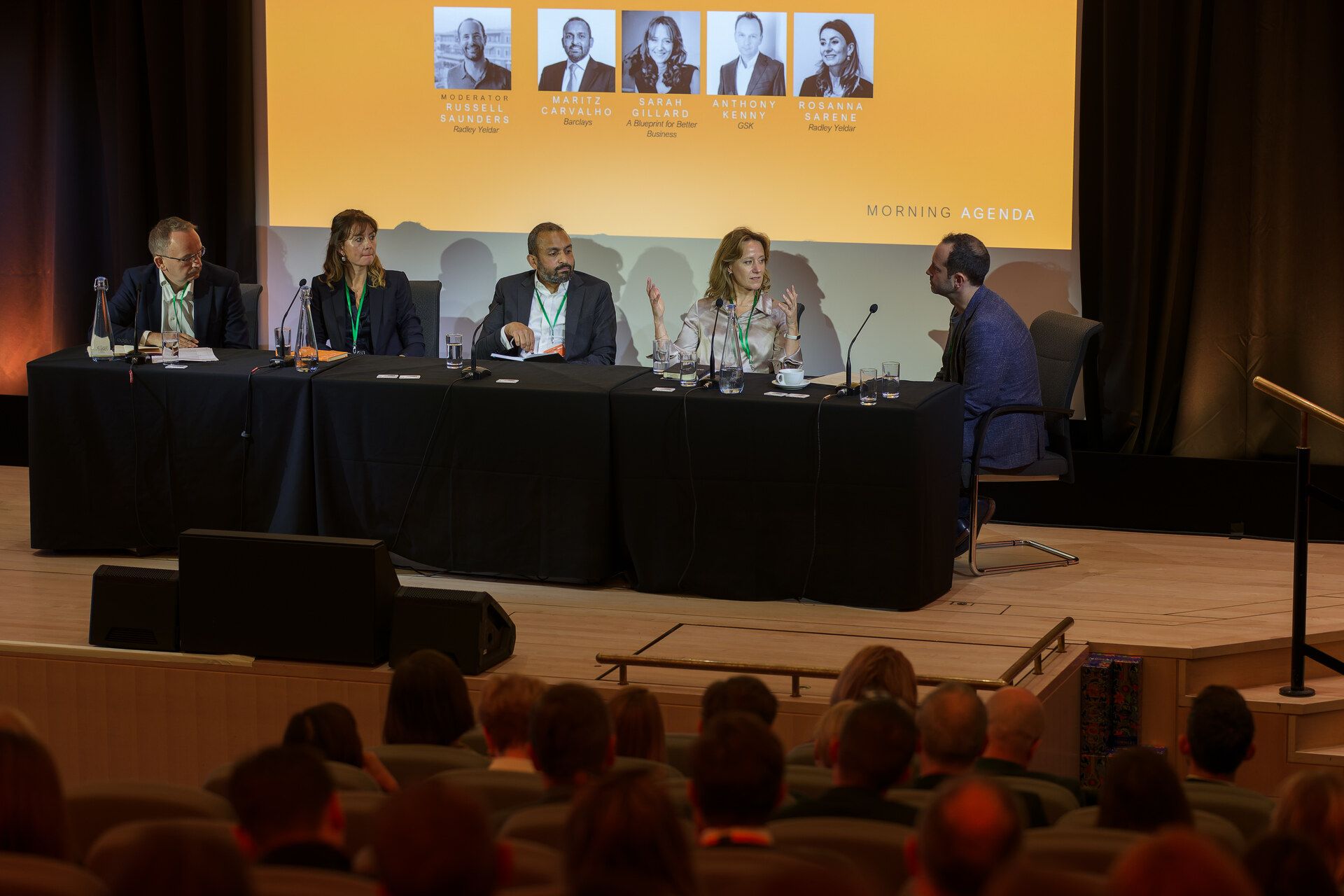
Many of the findings from Anthesis Group’s research resonate with a panel discussion at our recent Corporate Affairs Summit. Moderated by Russell Saunders, head of strategy at sponsors Radley Yeldar, the panel discussed how, in this age of polarisation, accusations of woke capitalism and the weaponisation of ESG, companies can navigate these obvious tensions while staying true to their values.
As Sarah Gillard, CEO, A Blueprint for Better Business, set the scene: business does not operate in a vacuum. It has to respond to the context in which it is situated. Climate change is a reality. Inequality is enormous. Technological changes, accelerated by the arrival of AI, are happening. Wellbeing challenges, mental and physical, are still here.
‘If businesses want to remain relevant in a changing world, they are going to have to work out how they become part of the solution rather than part of the problem,’ posited Gillard.
She added that businesses need to work out the narrative, and the necessary actions aligned to this, that demonstrate how they are contributing to a better future ‘because that is still super important to their employees, their suppliers, their investors and to future generations’.
From the investor side, Maritz Carvalho, vice president of investor relations, Barclays, observed that, after a period of reflection earlier this year, as shareholders sought to understand the environment in which they now operated, ‘investors have returned to the table and are actually looking at the details [of companies’ sustainability stories], starting to assess how the actions that a company takes impacts them, how it impacts their shareholders, their investors, their clients. Their clients are still asking the same questions: they need to understand how their investments are delivering sustainability.’
Carvalho added that the sustainability discussion is ‘completely different’ from one about financial performance.
‘It is very granular. It is very detailed. It is more of a conversation about what works, what do we expect of you and what you, as an investor, can help us with on this journey,’ he said.
‘Everybody is in the same position. They are striving to deliver a long-term sustainable investment. The constructive discussion we are now starting to have is, I feel, almost the next stage… moving on from setting the goalposts, targets and objectives to actually How are you now delivering this? This is a linear journey that is evolving, and continues to evolve.’
Anthony Kelly, assistant general counsel, GSK, added that legal, working with external lawyers and corporate affairs, has been at the heart of unpicking the complex environment to understand how best to deal with it.
‘On the one hand, you have these executive orders. It isn’t rhetoric. The Department of Justice is actively enforcing and investigating: if you have a big customer base in the US, you have to take it seriously. If you’re applying for a government tender, you’ll be asked about what you say and what you don’t say will be scrutinised,’ he said.
‘You’ve got top level orders, state challenges, federal… all of that to work through, and then you’ve got to map that against the global network of laws and regulations that are expanding on a continuous basis.
‘But it is important that we navigate a way through so that we can continue, because these changes that were happening, through DE&I, ESG or sustainability et cetera, they were important but they [take a long time to achieve]. If you stop them, it has a massive impact. It will take a long time to recover.’
Radley Yeldar’s integrated reporting strategy director Rosanna Sarene found that some ‘extremely low risk companies have rowed back hugely, and stripped entire reports on every single mention of DE&I. You’ve got the mid-range, where most people sit, where instead of DE&I, they use [terms like] culture and inclusion.
‘And then you have some really exciting examples, like Levi’s in April, [where 99% of shareholders wanted them to continue with their DE&I programmes], which was matched by really strong rhetoric put out by the leadership. As a result, Levi’s share price went up and they sold more jeans.
‘I think you could argue that those companies who quickly abandoned commitments, it suggests that their original vision lacked credibility. Unless you have really had that strong articulation of your purpose, your strategy, your vision, then it is easy to be buffeted by changing tides.’
Barclays’ Carvalho agreed, adding: 'There are reasons why companies do have to step back from certain commitments, but if you can strip that away, and show the next level of granularity Why did we come up with that policy or that direction in the first place? Why is this important for our company?, then that really helps to build trust. It doesn’t change your overall direction, you’re on the same route. And that’s where we’ve had a lot more engagement on the sustainability side than in previous years.
‘It’s about understanding your investor, and making it clear to them where your targets and policies are, where they’re embedded, and how they then filter down into your purpose and vision of the direction of the company.
‘The investor is better informed so that, if there is potentially negative media, they can see through that and understand where the company is heading.’
ODD & SOD - JUST THE ONE THIS WEEK, AS THEY SAY ON HIGNFY
🌬️American business leaders adjust their messaging around corporate culture according to the prevailing political climate, and how that may align with their own personal views, a new report claims. But the way they talk about values can also have tangible results.
Corporate culture messaging and national politics analyses the corporate earnings calls and quarterly meetings of almost 3,400 US firms with investors and analysts between 2002 to 2020, considering how the five most frequently discussed values – integrity, teamwork, innovation, quality and respect – are represented.
Two trends emerged.
Political alignment
When executives or firms are aligned with the sitting president, they will stress corporate culture more strongly. The research found that pride and optimism drives these messages, particularly around innovation, quality and resect.
Political misalignment
When executives or firms are politically opposed to an administration, they tend to downplay the values associated with pride and optimism, highlighting only neutral or product-focused messaging.
Prior to Barack Obama’s election in 2020, these differences were pronounced but, over the past 15 years, as political polarisation has increased, firms have become remarkably similar in the way they talk about corporate culture – described in the report as ‘an unwritten belief system’.
As author Kate Holland, professor at University of New Mexico’s Anderson School of Management, puts it: ‘When political polarisation goes up, firms choose to talk less in general about everything that’s not directly related to their product.’
However, this focus, particularly when it is linked to corporate values, can lead to tangible outcomes.
💡Innovation: firms that speak more about innovation tend to be more adaptable, producing more patents and generating more citations.
✅Quality: firms emphasising quality often produce higher-rated goods, evaluated by consumer reports and ratings agencies.
🫡Respect: firms highlighting respect often excel in CSR and ESG rankings, and invest in employees and DEI initiatives.
👥Teamwork: firms stressing teamwork are more likely to engage in joint ventures and strategic alliances.
⚖️Integrity: firms stressing integrity are less likely to be investigated by the SEC or to restate earnings.
Should corporate culture be measured like revenue?
That’s certainly the view of a new report by Julie Kratz, a professor focused on workplace culture at the Kelley School of Business at Indiana University, published in Forbes.
In conversation with Kae Kronthaler-Williams, author of a new book Not Made for You, they argue that, in these days of labour shortages and the changing workplace expectations of younger generations, a focus on retention and creating a thriving environment is business critical.
The duo suggest four areas to focus on:
Set retention as a key metric
Resignations can be a lagging indicator of culture, and the reasons for these can be telling: burnout, feeling unsupported or limited career progression. Focusing on these can be a direct way to address culture.
Audit workloads
If burnout is an issue, are the daily expectations realistic for a single person? Does the burden of administrative work, which could be automated, fall disproportionately onto women or marginalised employees?
Prioritise the ‘how’ in performance
It is not enough to simply perform, it is how you perform that is important. Does a star performer create a toxic work environment that ultimately leads to others’ departures? Instead, they recommend individuals who lead with empathy; are actively trying to upskill their abilities, and are the ‘culture makers’ in the department.
Support the middle manager
Managers are often expected to bring the employee experience to life, to cascade down the messages from the top to their teams. But they are often poorly equipped to do so. They recommend offering training that helps managers to manage, by offering advice on giving constructive feedback or leading with empathy, as well as coaching skills so that they can help their colleagues tackle issues (thus developing skills) rather than sorting out all their problems.