- Corporate Affairs Unpacked
- Posts
- The media is in a state
The media is in a state
Sorry. Rewind. That should say The State of the Media!

Helen Dunne
May 15, 2026 • Estimated Reading Time: 6 minutes

How would you feel if you received ten unsolicited sales calls a day, of which barely three might merit some attention?
That’s the reality facing many journalists today, according to the latest State of the Media report by Cision, which recently surveyed more than 1,800 hacks across 19 markets to understand what they want from PRs.
Clogged up in-boxes was not one of the answers, but more than half those surveyed – 57 per cent – claim they receive more than 50 PR pitches a week, with an unlucky 11 per cent receiving between 100 and 150. And here’s the kicker: more than half say that fewer than one in four is worth even reviewing.
And yet, if PRs get it right – and it still remains a big ‘if’ – pitching could be a really worthwhile task. With shrinking resources and tight deadlines, journalists are relying on PRs more than ever. Two in three (66 per cent) now say that PR provided-content is their top source for content, which, truth be told, I find a bit depressing. No disrespect, but there’s no feeling in the world like a proper, investigative scoop!
So what makes a pitch stand out? Well, an overwhelming four in five hacks say it needs to be relevant to their beat, audience or coverage – no kidding, Sherlock – while only 35 per cent worry about it being timely or having a newsworthy angle, which seems a bit bizarre, and just asking for PRs to rehash releases that initially received no coverage – probably for good reason.
Exclusive opportunities or personalised pitches merit attention, but increasingly hacks are asking for pitches with credible data or research in a world where misinformation is rife. Having fought against pointless embargoes, it seems that journalists are now embracing these and early access as it allows them time to research and fact-check.
But keep it short. Journalists do not want a marketing brochure nor a pitch document for your credentials: with a few exceptions, 100 to 200 words is the ideal length. And then you should follow the old dating advice – don’t seem too keen. One follow up call is sufficient for two thirds of respondents.
However, if your pitch does pique a journalist’s interest then nine per cent expect a response to their queries within minutes, while 30 per cent will settle for an hour. And 52 per cent – who obviously are not writing for dailies – will tolerate a response within 24 hours.
While full of interesting statistics and insights – who knew that 84 per cent of hacks would prefer to build a relationship with PRs before getting an unsolicited pitch? (although admittedly by email rather than the time honoured tradition of a pub!) – the report also makes for depressing reading,
Many of the hacks’ complaints are unchanged from those voiced by me and my colleagues working on national newspapers some 20 years ago (although admittedly, we weren’t harassed by flacks on social media or WhatsApp).
The journalists’ biggest whinges remain irrelevant press releases (72 per cent), pitches that sound like marketing brochures (49 per cent), providing inaccurate information (40 per cent), following up repeatedly (38 per cent) and failing to respond before deadlines (13 per cent).
The personal gripes take some beating, with complaints about receiving unfinalised releases, followed by multiple rewrites; promises to deliver subject experts or CEOs, who never materialise; or leaving journalists hanging before deadlines. As one said: ‘Always remember, reporter today could be editor tomorrow – and ban your agency/comms team.’
This is where the professionalisation of the industry should start. Sorting out the basics. Not with the definition of PR.
CORPCOMMS AWARDS
How Virgin Media O2 got its mojo back
Nicola Green, chief communications and corporate affairs officer at Virgin Media O2, knows all about high-performing teams.
At last year’s CorpComms Awards, Virgin Media O2 picked up six trophies 🏆🏆🏆🏆🏆🏆– a record haul in the competition’s 19 year history.
Her team picked up Best corporate campaign for its Fight for Fairer Ticketing, Best embodiment of corporate purpose, for its long-standing National Databank initiative, a sort of food bank for mobile data, two trophies for its groundbreaking Daisy vs Spammers campaign, Best in-house communications team as well as the Grand Prix.
In case you missed those campaigns, the National Databank Christmas Campaign connected almost 54,000 people, with household incomes of less than £15,000, the Fight for Fairer Ticketing was a reaction to public outrage at inflated concert ticket prices on resale sites while Daisy vs Spammers was an ingenious campaign in which an AI generated granny frustrated spammers, by keeping them on the phone.
All had the customer at their centre. ‘We took a step back and asked What are the four things that we’re going to be famous for this year?’ explains Green. Building on an internal campaign, Choose Customer, she adds: ‘This was our way of going back to basics and asking: What do our customers care about? Where have we got an edge that our competitors haven’t? And Where can we really make a difference?’
But this also required a different approach because, as Green points out, these are long-term projects. ‘They take time, expense and focus,’ she explains. Her team now has members working on short-term initiatives, such as new products and services; some focused on longer-term projects while others may work on both. ‘It is about being very clear on who owns it,’ she adds.
The real key to success, however, was working hand-in-hand with marketing, and advertising – but from a different perspective - as well as internal comms and government affairs.
These campaigns were comms first, then marketing. ‘How many times in an organisation does marketing go We’re going to fly people around the world and they’re going to do X, Y, Z, and we say We can’t do anything with that?’ she asks. ‘We flipped it over, and asked Why don’t you jump on the back of some of our ideas that we’ve been working on for a year or so and help elevate them?’
As Green explains, historically marketing might want to promote O2’s sponsorship of a music venue, which is a hard sale for comms, but this campaign focused on what customers cared about. Ticket prices. There was also a business case: people were buying tickets through O2’s Priority app, and then selling these on for a profit.
‘We had a business issue that we needed to address because our tickets weren’t getting into the right hands. They were going to touts. Business really got behind it. You can either win or lose with campaigning, which I love. Our objective was clear: to get the government to deal with ticket touts, which they did.’
In November 2025, the government announced a ban on selling tickets above original price and a cap on service fees charged by resell sites. ‘Our people see it. They believe it. They can talk about it. And now they want to do more.’
From first highlighting the issue of ticket touts to effecting government action took, conservatively, two and a half years. ‘Agencies come up with ideas which are very much of the moment. We need to take a longer-term view about where we are going, and be comfortable with that burden,’ adds Green.
‘You also need to reinvent as you go. Getting celebrities to support our campaign was one way, talking to MPs and getting them involved was another. There are lots of little things you need to do in order to build a campaign, rather than just a one-off [blast].’
Virgin Media O2’s next big campaign is around digital wellbeing for adults, rather than children, ‘because, let’s be honest, I’m just as addicted to my mobile and the algorithms, as my son or daughter’.
‘We’re working with marketing. We’re taking a step back. We’re thinking about where we need to be heading and what we need to do. There’s going to be lots of different elements,’ explains Green. ‘But as I explained to my team, it may not be this year that we get a big hit. It may be next year.’
She has also taken a different approach to this campaign. For the first time, the idea was floated with colleagues – and the response was phenomenal. ‘We connect millions of people. We have a responsibility for the over-16s, just as much as younger people. It gives our colleagues credibility to talk positively about the organisation to their friends and family. They’re really getting behind it and we will use the throughout the campaign.’
But, as Green admits, her team does not have all the answers. ‘It’s no longer about one discipline. It is about collaboration. It will either work or it won’t work. And, do you know what? I’m quite happy if things don’t work out, because you’ve got to try, but again it’s about the long burn rather than short wins. I know that, with digital wellbeing, where we start and where we’re heading may not be where we get traction. You iterate as you go.’
She admits this a change of approach. ‘In the old days, I was very fixed on This is our idea. We’ll just stick with it and then it will either work or it won’t. Whereas now, I think that long-burn, changing it up, dialling it down in another area, is the way forward.’
Let’s just hope it’s the way forward to some more trophies… if not this year... In a horrendously obvious plug – the CorpComms Awards are now open!
The early bird deadline is 12 June 2026, and entries until that date will be priced at £350+VAT after which they jump by £100 to £450+VAT until the final closing date of 26 June.
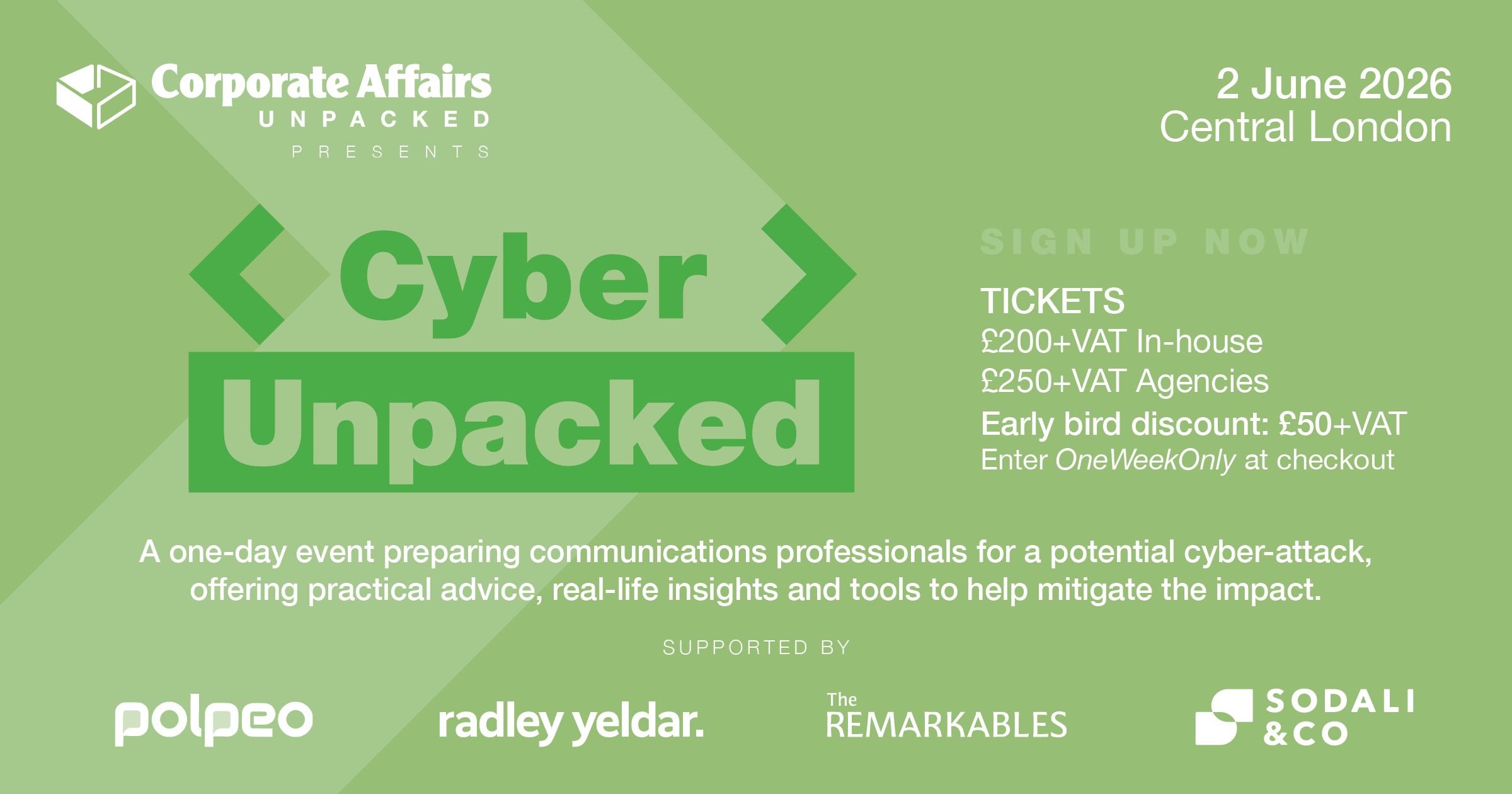
DISCOUNTED TICKETS AVAILABLE: SIMPLY ADD OneWeekOnly AT CHECKOUT FOR £50 OFF